
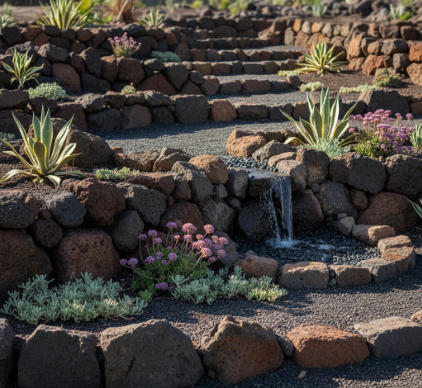
Volcanic rock isn’t just debris from nature’s temper tantrums—it’s the Swiss Army knife of garden design. Scoria, pumice, obsidian: each one formed under conditions that would vaporize your entire neighborhood, now sitting pretty in your backyard like nothing ever happened.
When Lava Cools Down and Pretends to Be Useful
Pumice might look like fossilized Swiss cheese, but it’s actually what happens when lava gets so excited it traps gas bubbles mid-explosion. Mount Mazama blew its top 7,700 years ago, creating Crater Lake and scattering pumice across Oregon like confetti at the world’s most violent party. That rock floats. Literally floats on water because it’s more air than stone, which makes it perfect for aerating soil without adding weight—a trick every orchid grower in Miami learned by 1995 when hurricane season turned regular mulch into projectiles.
Here’s the thing about scoria: it’s volcanic rock’s moody teenager phase.
Basaltic lava froths up, cools fast, and boom—you’ve got rust-colored chunks with holes like a geological sponge. The 1943 eruption of Parícutin in Mexico created enough scoria to bury two villages and supply landscapers for decades. Use it as mulch and watch how it regulates soil temperature while looking like you imported Mars. The iron oxide content means it weathers to that deep red-brown that makes succulents pop visually, plus it doesn’t decompose, so you’re not replacing it every spring like some chump with pine bark.
Why Your Drainage Problems Are Actually Embarrassing
Volcanic rock laughs at water retention issues. Those vesicles—fancy word for holes—create air pockets that prevent root rot while maintaining moisture where it matters. In 2019, researchers at UC Davis published findings showing pumice-amended soil increased drought tolerance in Mediterranean gardens by 40% compared to traditional amendments. That’s not marketing speak; that’s peer-reviewed science telling you to get your act together.
Turns out, you can stack volcanic boulders without mortar if you’re not completely incompetent.
The Physics of Making Walls That Don’t Collapse Immediately
Dry-stacking works because volcanic rock is rough-textured and surprisingly light for its size. Builders in the Canary Islands have used this technique since the 15th century—their stone walls still standing while your fence panels blow over every winter. The porosity means roots can colonize the spaces between rocks, creating living architecture that gets stronger over time. Plant sedums, sempervivums, or that weird Delosperma cooperi with the day-glo purple flowers, and watch them turn structural necessity into Instagram bait.
When Black Glass Becomes a Garden Feature Instead of a Weapon
Obsidian forms when lava cools so fast it skips the whole “becoming proper rock” step and goes straight to volcanic glass. Ancient Mesoamericans used it for blades sharp enough to perform surgery; modern landscapers use it to create water features that catch light like shattered midnight. Crushed obsidian as pathway aggregate reflects moonlight with an intensity that makes solar lights look pathetic. Just wear gloves when handling it unless you enjoy explaining weird cuts to your doctor.
The Part Where We Talk About Actually Arranging This Stuff
Start with your largest pieces as anchors—think of them as geological punctuation marks. In Japanese karesansui gardens, volcanic rock represents mountains or islands, placed according to principles developed during the Muromachi period around 1400 CE. But you’re probably not aiming for Zen perfection, so just put big rocks where they look cool and fill gaps with smaller scoria or lava gravel. Layer textures: smooth river rock against jagged basalt, fine pumice against chunky scoria. The contrast makes each material more interesting, like how cilantro tastes better next to lime even though neither asked for your opinion.
Wait—maybe the real trick is accepting that volcanic rock gardens require almost zero maintainence once established. No weeding through decomposing wood chips, no annual refresh, no nutrient depletion. The rock just sits there, doing its geological thing, outlasting your mortgage and probably your grandchildren’s mortgages too.


