
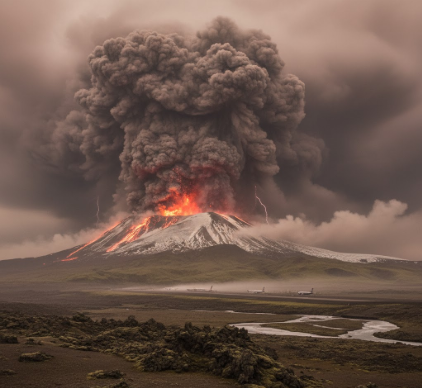
April 14, 2010. That’s when a volcano with a name like a keyboard sneeze—Eyjafjallajökull—decided to throw the planet’s aviation system into chaos.
The Icelandic volcano didn’t explode with the fury of Krakatoa or the devastation of Mount St. Helens. It just belched a plume of ash 9 kilometers into the atmosphere and basically said, “Good luck flying through that.” Over the next six days, European airspace became a no-fly zone affecting more than 10 million passengers. Airlines hemorrhaged roughly $1.7 billion. All because of pulverized rock floating in the jet stream.
When a Mountain Nobody Could Pronounce Became Everyone’s Problem
Here’s the thing about volcanic ash: it’s not like the stuff in your fireplace.
Volcanic ash particles are fragments of jagged glass and rock smaller than 2 millimeters, created when magma shatters during explosive eruptions. They’re abrasive enough to sandblast airplane windshields into opacity and hot enough to melt inside jet engines, where they re-solidify on turbine blades like geological superglue. The 1982 British Airways Flight 9 incident proved this when all four engines failed after flying through an ash cloud from Mount Galunggung in Indonesia. The plane dropped 24,000 feet before pilots managed to restart the engines. Passengers saw blue flames shooting from the engine nacelles. That kind of thing tends to make aviation regulators nervous.
Eyjafjallajökull’s eruption wasn’t even particularly large by volcanic standards—a VEI 4 on the Volcanic Explosivity Index, which runs from 0 to 8. Mount Pinatubo in 1991 was a VEI 6, ejecting 10 cubic kilometers of material. But Eyjafjallajökull had location. Sitting beneath a glacier, the eruption created a perfect storm: magma hitting ice, generating steam that shattered magma into microscopic particles, then jet streams carrying that ash directly over Europe’s busiest flight corridors.
The Economics of Grounded Metal Birds and Stranded Humans
Wait—maybe the real story isn’t the volcano at all. Maybe it’s how fragile our interconnected systems actually are.
Kenyan farmers watched roses rot in warehouses because they couldn’t ship flowers to European markets. Auto manufacturing plants in Germany shut down waiting for parts from Asia. A friend of mine spent three days sleeping in Madrid’s airport, surviving on overpriced sandwiches and existential dread. The eruption exposed just how dependent modern civilization is on the assumption that air travel works, always, without interruption.
Turns out the decision to ground flights was itself controversial. The threshold for safe ash concentration wasn’t based on hard science but on manufacturers’ recommendations from the 1980s. Some airlines conducted test flights through ash clouds and found no damage. Ryanair’s CEO called the shutdown “wildly over-restrictive,” though admittedly, that guy would probably fly through a hurricane if it saved €10 in fuel costs.
European authorities eventually created a three-tier system: no-fly zones, restricted zones, and enhanced procedures zones, allowing airlines to resume operations on April 20. By then, the damage was done—both economically and to the public’s sense that they controled their own travel plans.
Why Iceland Keeps Ruining Everyone’s Day From a Geological Perspective
Iceland sits on the Mid-Atlantic Ridge, where the North American and Eurasian tectonic plates are literally pulling apart at about 2.5 centimeters per year. That’s slower than your fingernails grow, but it’s enough to keep magma churning up from the mantle, creating roughly 30 active volcanic systems across the island.
Eyjafjallajökull’s name translates to “island mountain glacier,” which is both poetic and practical—Icelanders name things for what they see. The volcano had erupted before, most recently in 1821-1823, when it grumbled for over a year. That eruption triggered activity in nearby Katla, a much larger and more dangerous volcano. Scientists watched Katla nervously in 2010, but it stayed quiet. Katla erupts roughly every 60-80 years; its last major eruption was in 1918. Do the math and you’ll understand why volcanologists keep monitoring it.
The 2010 eruption actually started on March 20 with fissure eruptions on the volcano’s eastern flank—relatively gentle lava flows that attracted tourists who wanted Instagram photos before Instagram was really a thing. Then on April 14, the eruption shifted beneath the ice cap, and suddenly it wasn’t photogenic anymore. It was a global transportation crisis.
We’ve spent centuries building systems that assume geological stability. Volcanoes keep reminding us that assumption is temporary. Eyjafjallajökull wasn’t the Big One—that distinction probably belongs to Yellowstone or Campi Flegrei or some submarine volcano we haven’t even properly mapped yet. But it was loud enough to make us listen, even if we still can’t pronounce its name.


